
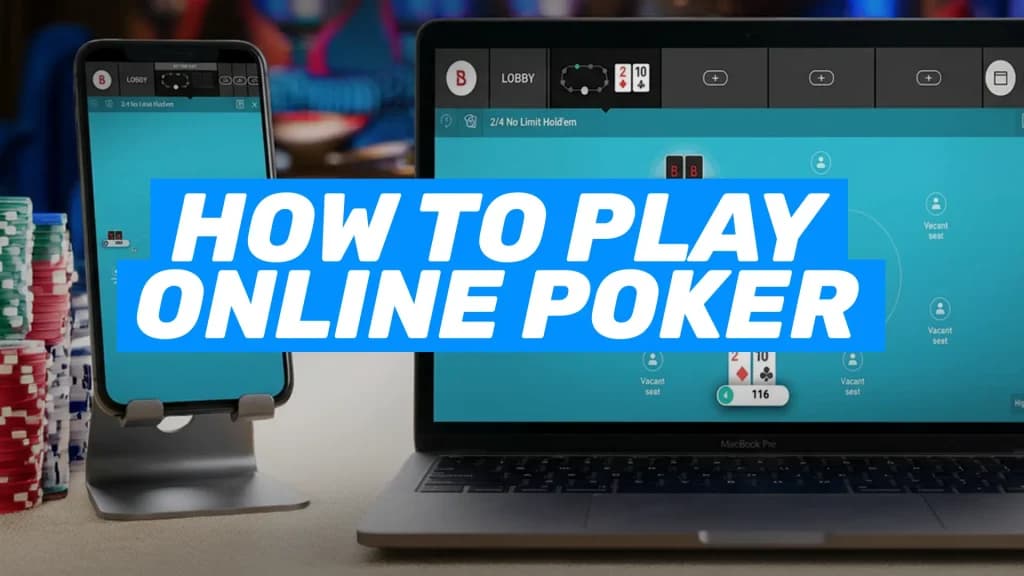
If you’ve dabbled in any game of chance, you’ve dabbled in online poker. It’s eaten up plenty of time on sports networks, it’s featured in movies, and it took over the online world in the early 2000s.
Learning how to play poker online opens your world to strategic thinking and mathematical probabilities. But to unlock your online poker brain, you need to understand the basic rules, hand rankings, betting options, and ways a hand can be won.
Bovada Poker offers cash games, sit-and-gos, multi-table tournaments, knockout tournaments, turbo events, and fast-fold Zone Poker. This guide will get you ready for all of it, with a strong focus on the most popular version of the game, Texas Hold’em.
Play Online Poker at Bovada Casino
Poker Rules
A Texas Hold’em hand begins with each player receiving two cards face down. These are called the hole cards and are visible only to the player who receives them.
Five community cards are then dealt face up in the middle of the table across three stages:
- The Flop: The first three community cards are dealt together.
- The Turn: A fourth community card is added.
- The River: The fifth and final community card is dealt.
Players use the available cards to make their strongest five-card poker hand. You may use both hole cards, one hole card, or neither hole card if the five community cards already form your best hand.
Betting takes place over four rounds:
- Pre-flop: After each player receives two hole cards.
- The Flop: After the first three community cards are dealt.
- The Turn: After the fourth community card appears.
- The River: After the final community card appears.
During a betting round, players may have several options:
- Check: Pass the action without betting when no bet has been made.
- Bet: Place the first wager of the round.
- Call: Match another player’s bet.
- Raise: Increase the size of an existing bet.
- Fold: Give up the hand and any chips already placed in the pot.
A hand can end in two ways. If at least two players remain after the River betting round, they reveal their cards at the showdown. The player with the best five-card hand wins the pot.
A player can also win without showing their cards. If everyone else folds, the last remaining player collects the pot regardless of what cards they hold.
Poker Hand Rankings
Knowing the poker hand rankings is essential. From strongest to weakest, the rankings are:
- Royal Flush: A, K, Q, J, and 10 of the same suit.
- Straight Flush: Five consecutive cards of the same suit.
- Four of a Kind: Four cards of the same rank.
- Full House: Three cards of one rank and two cards of another.
- Flush: Five cards of the same suit that are not consecutive.
- Straight: Five consecutive cards containing multiple suits.
- Three of a Kind: Three cards of the same rank.
- Two Pair: Two different pairs.
- One Pair: Two cards of the same rank.
- High Card: A hand without any of the combinations listed above.
When two players have the same type of hand, the higher cards determine the winner. A pair of Aces, for example, beats a pair of Kings.
If both players hold the same pair, their remaining cards are compared. These tie-breaking cards are called kickers. If a players’ best five-card hands are identical, they split the pot.
Game Types at Bovada Poker
Once you understand the rules, you can choose a poker format that fits your experience, bankroll, and playing time.
Cash Games
In cash games, your chips represent money. You can usually join or leave whenever you want, and the blinds stay the same level throughout the session.
Cash games can be a practical starting point for beginners because you control how long you play. You can start at microstakes tables, learn the software, and leave without waiting for a tournament to finish.
Sit-and-Go Tournaments
Sit-and-Go tournaments begin as soon as the required number of players registers and sit at the table. They have no scheduled time.
Each player pays an entry fee and receives the same starting chip stack. The blinds increase as the tournament progresses, and players are eliminated when they lose all their chips. The highest finishers divide the prize pool according to the event’s payout structure.
Multi-Table Tournaments
Multi-table tournaments, or MTTs, begin with players spread across multiple tables. As players are eliminated, the remaining field is consolidated until the tournament reaches its final table.
This tournament can offer large prize pools, but they may also require several hours to complete. The lower-cost MTTs allow beginners to experience the format without immediately risking a large amount.
Knockout Tournaments
Knockout tournaments award a bounty whenever you eliminate another player. Bounties are paid separately from the regular tournament prizes.
This changes certain decisions because the potential bounty may make it worthwhile to challenge a short-stacked opponent. However, chasing bounties without considering your cards, position, and chip stack can be costly.
Turbo Tournaments
Turbo poker tournaments ensure the blinds are fast and furious. Players have less time to wait for premium hands, and chip stacks can be eaten by the blinds quickly if players play too conservatively. Turbo events suit players who are short on time and patience.
Zone Poker
Zone Poker is Bovada’s fast-fold cash game. When you fold, you are immediately moved to another table and dealt a new hand.
You don’t have to wait for the previous hand to finish, allowing you to play more hands in less time. However, the faster pace can create a dizzying experience for novice players.
Limit Poker Explained
In poker, the term “limit” refers to the rules controlling how much a player can bet or raise. The three main structures are No-Limit, Pot-Limit, and Fixed-Limit.
No-Limit Poker
No-Limit poker allows you to bet any amount between the minimum permitted bet and your entire chip stack. Betting all your remaining chips is called going all-in.
Pot-Limit Poker
In Pot-Limit games, the maximum bet or raise depends on the size of the pot. You cannot automatically wager your entire stack unless the permitted pot-sized bet is large enough.
Pot-Limit is most closely associated with Omaha, although the structure can be used for other poker variants.
Fixed-Limit Poker
Fixed-Limit games use predetermined betting amounts. Players cannot select any amount they want when betting or raising.
This structure usually produces smaller swings than No-Limit because a player can’t normally lose an entire stack through a single bet.
Poker Bankroll Basics
Your poker bankroll is money set aside specifically for playing poker. It should not include money needed for housing, groceries, bills, savings, or other essential expenses.
Bankroll management helps you choose affordable stakes and handle losing sessions. Even skilled players experience short-term losses because the cards can produce unpredictable results.
For example, a 1-cent/2-cent cash game may have a standard maximum buy-in of $2. A $40 bankroll would provide 20 full buy-ins at that level. Tournament players generally need more buy-ins because most entrants do not receive a payout. A $100 bankroll provides 100 entries for $1 tournaments.
These figures are starting guidelines, not guarantees against losing. If your bankroll declines significantly, move down to a lower stake. If it grows through consistent results, consider moving up gradually rather than making a sudden jump.
Poker Strategy for Beginners
Learning how to play poker online requires more than memorizing the rules. Several basic strategies and concepts can help you make smart decisions.
Start by playing stronger starting hands: Entering every pot may seem entertaining, but weak hands frequently create difficult situations after the Flop. Folding more marginal hands before the Flop protects your chips.
Position is also important: When you act later in a betting round, you see what other players do first. That information can help you decide whether to bet, call, raise, or fold.
Learning when to fold is just as important as knowing when to bet: Folding doesn’t necessarily mean you made a mistake. It can preserve your chip stack when you believe your opponent has a better hand.
Understand your pot odds: Pot odds compare the amount you must call with the size of the pot you could win. If the potential reward is large enough relative to the cost – and your hand has a realistic chance of improving – a call may be mathematically justified.
Avoid trying to recover losses quickly: Increasing your stakes or playing too many hands after a bad result is known as chasing losses and can lead to bigger mistakes. Take a break if frustration begins influencing your decisions.
Advanced Poker Strategies
Once you understand the basics, start considering the hands an opponent might have instead of trying to identify one exact hand. This collection of possible hands is called a range. For example, a player who raises from an early position will usually have a stronger range than someone who raises from a later position.
You can also begin using re-raises:
- A 3-bet is the first re-raise. For example, one player raises, and you raise again.
- A 4-bet occurs when the original raiser raises your 3-bet.
Players usually 3-bet or 4-bet to build a larger pot with a strong hand. These moves can also be used as bluffs against opponents who are likely to fold, but beginners should use them carefully.
A bluff is most convincing when your betting matches the strong hand you are trying to represent. Consider the community cards, how you played earlier in the hand, and whether your opponent is willing to fold. Bluffing too often makes your play predictable and easier to call.
Advanced players also adjust their strategy to each opponent. This is called exploitative poker. Against someone who calls too often, bet your strong hands more frequently. Against someone who rarely folds, reduce your bluffs.
How to Play Poker Online: Frequently Asked Questions
How do you play poker online?
Create an account, select a game, and join a table or tournament. The software deals the cards and manages each betting round. In Texas Hold’em, the best five-card hand wins at showdown unless every other player folds first.
What are the basic Texas Hold’em rules?
Each player receives two private hole cards. Five community cards are dealt across the Flop, Turn, and River. Players create their best five-card hand from the seven available cards.
What is limit poker?
Limit poker describes how betting is controlled. No-Limit permits bets up to your entire stack, Pot-Limit caps bets according to the pot’s size, and Fixed-Limit uses predetermined amounts.
How much money do beginners need?
That depends on the chosen stakes. Approximately $40 provides 20 full $2 buy-ins for 1-cent/2-cent cash games, while $100 provides 100 entries into $1 tournaments. Only play with an amount you can afford to lose.
You now know the rules, hand rankings, game formats, and essential strategies. Visit Bovada Poker to choose a cash game, enter a tournament, or try Zone Poker. Your table is waiting.
If you’ve dabbled in any game of chance, you’ve dabbled in online poker. It’s eaten up plenty of time on sports networks, it’s featured in movies, and it took over the online world in the early 2000s.
Learning how to play poker online opens your world to strategic thinking and mathematical probabilities. But to unlock your online poker brain, you need to understand the basic rules, hand rankings, betting options, and ways a hand can be won.
Bovada Poker offers cash games, sit-and-gos, multi-table tournaments, knockout tournaments, turbo events, and fast-fold Zone Poker. This guide will get you ready for all of it, with a strong focus on the most popular version of the game, Texas Hold’em.
Poker Rules
A Texas Hold’em hand begins with each player receiving two cards face down. These are called the hole cards and are visible only to the player who receives them.
Five community cards are then dealt face up in the middle of the table across three stages:
- The Flop: The first three community cards are dealt together.
- The Turn: A fourth community card is added.
- The River: The fifth and final community card is dealt.
Players use the available cards to make their strongest five-card poker hand. You may use both hole cards, one hole card, or neither hole card if the five community cards already form your best hand.
Betting takes place over four rounds:
- Pre-flop: After each player receives two hole cards.
- The Flop: After the first three community cards are dealt.
- The Turn: After the fourth community card appears.
- The River: After the final community card appears.
During a betting round, players may have several options:
- Check: Pass the action without betting when no bet has been made.
- Bet: Place the first wager of the round.
- Call: Match another player’s bet.
- Raise: Increase the size of an existing bet.
- Fold: Give up the hand and any chips already placed in the pot.
A hand can end in two ways. If at least two players remain after the River betting round, they reveal their cards at the showdown. The player with the best five-card hand wins the pot.
A player can also win without showing their cards. If everyone else folds, the last remaining player collects the pot regardless of what cards they hold.
Poker Hand Rankings
Knowing the poker hand rankings is essential. From strongest to weakest, the rankings are:
- Royal Flush: A, K, Q, J, and 10 of the same suit.
- Straight Flush: Five consecutive cards of the same suit.
- Four of a Kind: Four cards of the same rank.
- Full House: Three cards of one rank and two cards of another.
- Flush: Five cards of the same suit that are not consecutive.
- Straight: Five consecutive cards containing multiple suits.
- Three of a Kind: Three cards of the same rank.
- Two Pair: Two different pairs.
- One Pair: Two cards of the same rank.
- High Card: A hand without any of the combinations listed above.
When two players have the same type of hand, the higher cards determine the winner. A pair of Aces, for example, beats a pair of Kings.
If both players hold the same pair, their remaining cards are compared. These tie-breaking cards are called kickers. If a players’ best five-card hands are identical, they split the pot.
Game Types at Bovada Poker
Once you understand the rules, you can choose a poker format that fits your experience, bankroll, and playing time.
Cash Games
In cash games, your chips represent money. You can usually join or leave whenever you want, and the blinds stay the same level throughout the session.
Cash games can be a practical starting point for beginners because you control how long you play. You can start at microstakes tables, learn the software, and leave without waiting for a tournament to finish.
Sit-and-Go Tournaments
Sit-and-Go tournaments begin as soon as the required number of players register and sit at the table. They have no scheduled time.
Each player pays an entry fee and receives the same starting chip stack. The blinds increase as the tournament progresses, and players are eliminated when they lose all their chips. The highest finishers divide the prize pool according to the event’s payout structure.
Multi-Table Tournaments
Multi-table tournaments, or MTTs, begin with players spread across multiple tables. As players are eliminated, the remaining field is consolidated until the tournament reaches its final table.
This tournament can offer large prize pools, but they may also require several hours to complete. The lower-cost MTTs allow beginners to experience the format without immediately risking a large amount.
Knockout Tournaments
Knockout tournaments award a bounty whenever you eliminate another player. Bounties are paid separately from the regular tournament prizes.
This changes certain decisions because the potential bounty may make it worthwhile to challenge a short-stacked opponent. However, chasing bounties without considering your cards, position, and chip stack can be costly.
Turbo Tournaments
Turbo poker tournaments ensure the blinds are fast and furious. Players have less time to wait for premium hands, and chip stacks can be eaten by the blinds quickly if players play too conservatively. Turbo events suit players who are short on time and patience.
Zone Poker
Zone Poker is Bovada’s fast-fold cash game. When you fold, you are immediately moved to another table and dealt a new hand.
You don’t have to wait for the previous hand to finish, allowing you to play more hands in less time. However, the faster pace can create a dizzying experience for novice players.
Limit Poker Explained
In poker, the term “limit” refers to the rules controlling how much a player can bet or raise. The three main structures are No-Limit, Pot-Limit, and Fixed-Limit.
No-Limit Poker
No-Limit poker allows you to bet any amount between the minimum permitted bet and your entire chip stack. Betting all your remaining chips is called going all-in.
Pot-Limit Poker
In Pot-Limit games, the maximum bet or raise depends on the size of the pot. You cannot automatically wager your entire stack unless the permitted pot-sized bet is large enough.
Pot-Limit is most closely associated with Omaha, although the structure can be used for other poker variants.
Fixed-Limit Poker
Fixed-Limit games use predetermined betting amounts. Players cannot select any amount they want when betting or raising.
This structure usually produces smaller swings than No-Limit because a player can’t normally lose an entire stack through a single bet.
Poker Bankroll Basics
Your poker bankroll is money set aside specifically for playing poker. It should not include money needed for housing, groceries, bills, savings, or other essential expenses.
Bankroll management helps you choose affordable stakes and handle losing sessions. Even skilled players experience short-term losses because the cards can produce unpredictable results.
For example, a 1-cent/2-cent cash game may have a standard maximum buy-in of $2. A $40 bankroll would provide 20 full buy-ins at that level. Tournament players generally need more buy-ins because most entrants do not receive a payout. A $100 bankroll provides 100 entries for $1 tournaments.
These figures are starting guidelines, not guarantees against losing. If your bankroll declines significantly, move down to a lower stake. If it grows through consistent results, consider moving up gradually rather than making a sudden jump.
Poker Strategy for Beginners
Learning how to play poker online requires more than memorizing the rules. Several basic strategies and concepts can help you make smart decisions.
Start by playing stronger starting hands: Entering every pot may seem entertaining, but weak hands frequently create difficult situations after the Flop. Folding more marginal hands before the Flop protects your chips.
Position is also important: When you act later in a betting round, you see what other players do first. That information can help you decide whether to bet, call, raise, or fold.
Learning when to fold is just as important as knowing when to bet: Folding doesn’t necessarily mean you made a mistake. It can preserve your chip stack when you believe your opponent has a better hand.
Understand your pot odds: Pot odds compare the amount you must call with the size of the pot you could win. If the potential reward is large enough relative to the cost – and your hand has a realistic chance of improving – a call may be mathematically justified.
Avoid trying to recover losses quickly: Increasing your stakes or playing too many hands after a bad result is known as chasing losses and can lead to bigger mistakes. Take a break if frustration begins influencing your decisions.
Advanced Poker Strategies
Once you understand the basics, start considering the hands an opponent might have instead of trying to identify one exact hand. This collection of possible hands is called a range. For example, a player who raises from an early position will usually have a stronger range than someone who raises from a later position.
You can also begin using re-raises:
- A 3-bet is the first re-raise. For example, one player raises, and you raise again.
- A 4-bet occurs when the original raiser raises your 3-bet.
Players usually 3-bet or 4-bet to build a larger pot with a strong hand. These moves can also be used as bluffs against opponents who are likely to fold, but beginners should use them carefully.
A bluff is most convincing when your betting matches the strong hand you are trying to represent. Consider the community cards, how you played earlier in the hand, and whether your opponent is willing to fold. Bluffing too often makes your play predictable and easier to call.
Advanced players also adjust their strategy to each opponent. This is called exploitative poker. Against someone who calls too often, bet your strong hands more frequently. Against someone who rarely folds, reduce your bluffs.
How to Play Poker Online: Frequently Asked Questions
How do you play poker online?
Create an account, select a game, and join a table or tournament. The software deals the cards and manages each betting round. In Texas Hold’em, the best five-card hand wins at showdown unless every other player folds first.
What are the basic Texas Hold’em rules?
Each player receives two private hole cards. Five community cards are dealt across the Flop, Turn, and River. Players create their best five-card hand from the seven available cards.
What is limit poker?
Limit poker describes how betting is controlled. No-Limit permits bets up to your entire stack, Pot-Limit caps bets according to the pot’s size, and Fixed-Limit uses predetermined amounts.
How much money do beginners need?
That depends on the chosen stakes. Approximately $40 provides 20 full $2 buy-ins for 1-cent/2-cent cash games, while $100 provides 100 entries into $1 tournaments. Only play with an amount you can afford to lose.
You now know the rules, hand rankings, game formats, and essential strategies. Visit Bovada Poker to choose a cash game, enter a tournament, or try Zone Poker. Your table is waiting.
Sign up to Bovada today